First 1000 Days & Double Burden of Malnutrition
What I learnt in workshop (UNICEF, IAP) at Mumbai.
In OPD and in the community, we often see:
1) large mother with small child,
2) small mother with large child,
3) a small infant becoming overweight in school age,
4) one small child and another large child of the same mother.
We notice this. We wonder… and then we leave it at that. We rarely ask — why has this disparity occurred? We should, in fact, find out why and institute remedial measures. That is our job.
Same house. Same kitchen. Same mother. But different nutritional outcomes.
Children: undernutrition, overnutrition.
Mother: undernutrition, overnutrition.
This is not a food quantity problem. It is a nutrition quality problem. A behaviour problem. A
caregiver ecosystem problem. It is not enough to say, “Child is underweight, give more food…”
or “Child is overweight, give less food…” Instead, we need to understand how the family eats.
Because this family is not suffering from lack of food. They are suffering from lack of direction.
This is the double burden of malnutrition (DBM) — right in front of us.
We already knew a great deal. Malnutrition, undernutrition, overnutrition, marasmus,
kwashiorkor, PCM, PEM, PJM (joules), SAM, MAM, ecology of malnutrition, growth, growth
curves, growth monitoring, anthropometry, anthropometric indices, percentile charts, ICMR,
IAP, NCHS, WHO, hidden hunger, micronutrient deficiencies. Our understanding has been
evolving over decades.
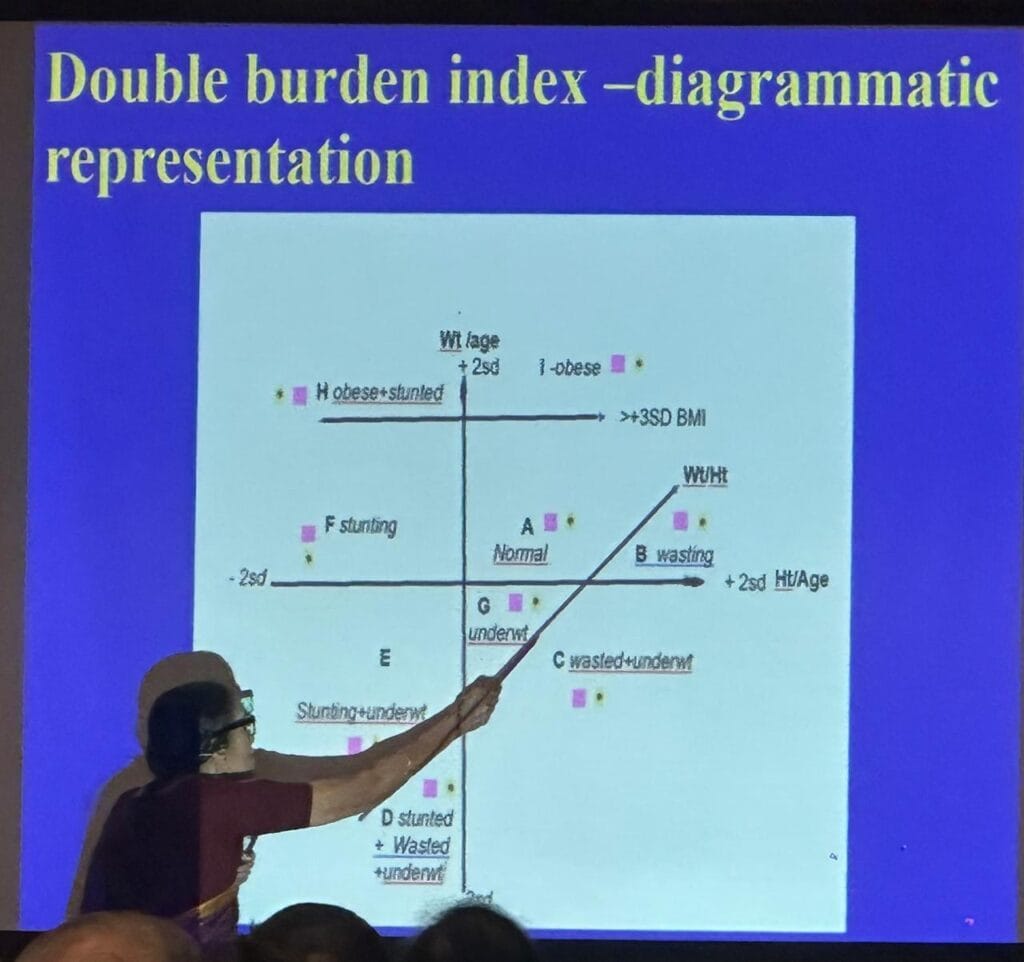
The Mumbai workshop gave a newer and better point of view. Nutritional assessment through
a life-course approach — from intrauterine life to adulthood.
A standardized, easy to understand and easy to use tool, the Double Burden Index (DBI), for
assessing and classifying nutritional status across ages, situations, and purposes. DBI is for
seeing today’s nutrition, understanding the past, and anticipating the future. Because nutrition
is not a moment. It is a journey.
Double burden of malnutrition (DBM) refers to the coexistence of undernutrition and
overnutrition within the same individual, household, or community. One person can experience
both undernutrition and overnutrition in the same life. One family can have both at the same
time. One community can have both at the same time.
We learnt the importance of time in nutrition. Undernutrition during the foetal period and early
childhood is common. It leads to biological adaptations — metabolic programming, an
adjustment to scarcity. This is followed by excess or imbalanced nutrition later in life. The result
is a metabolic mismatch. It increases the risk of non-communicable diseases. What protects the
foetus in scarcity may harm the adult in abundance.
The Double Burden Index (DBI) is a visual tool. Children cannot be only either undernourished
or overnourished. Multiple forms of malnutrition may coexist within the same child across time.
This shifts clinical thinking from a static to a dynamic, longitudinal perspective.
We have to think beyond nutritional interventions. Addressing only undernutrition or only
obesity is insufficient. We have to consider the life cycle — from maternal health to early
childhood and beyond.
From a clinical and public health point of view, DBI encourages pediatricians to look beyond
symptoms and signs and assess the nutritional history and context of the child. It suggests
strengthening the caregiver ecosystem. Families and communities need to be informed in a
language they understand.
We must understand the DBI chart and how to use it — to see the problem, not just understand
it.
This chart shows that the child is not just undernourished or overnourished. The same child can
be both. On this graph, we are not plotting numbers. We are plotting real children we see every
day in OPD.
The horizontal axis represents BMI, from thin to obese. The vertical axis represents height for
age, from stunted to normal or tall. Every point on this graph is a child with a story.
At the center is the child we all want — normal height and normal weight. In the lower right are
wasted children, thin for height, representing acute undernutrition. In the lower left are
stunted children, short for age, representing chronic undernutrition. In the upper right are
overweight children, who may appear healthy but are metabolically at risk. In the upper left is
the double burden child — short but overweight. Undernourished in early life, overnourished
later. Biology confused, metabolism strained.
We have all seen this. A large mother with a small child, a small mother with a large child, or
two siblings — one thin and one obese. But we rarely stop to ask why. This framework provides
the answer.
Double burden is not two separate problems. It is one life-course problem. Early undernutrition
leads to stunting. Later excess leads to obesity. The result is a high-risk phenotype. The body is
programmed for scarcity but is forced to live in abundance. This reflects Barker’s hypothesis.
Earlier we used to ask — is the child undernourished or overnourished? Now we must ask —
how many forms of malnutrition exist in this same child?
So when we see a child, we are not seeing today’s nutrition. We are seeing the history of
nutrition.
Malnutrition is not only a medical problem. It is also a social problem. The pediatrician’s role
must expand from clinical care to community engagement, caregiver education, and knowledge
transfer.
In summary, the most important shift is from viewing malnutrition as a single condition to
understanding it as a continuum shaped by time, environment, and biology. This perspective
has significant implications for both clinical practice and program design.
– Dr. Anil Mokashi (Pediatrician)
MBBS, MD, DCH, FIAP, PhD
(Child Growth and Development)